
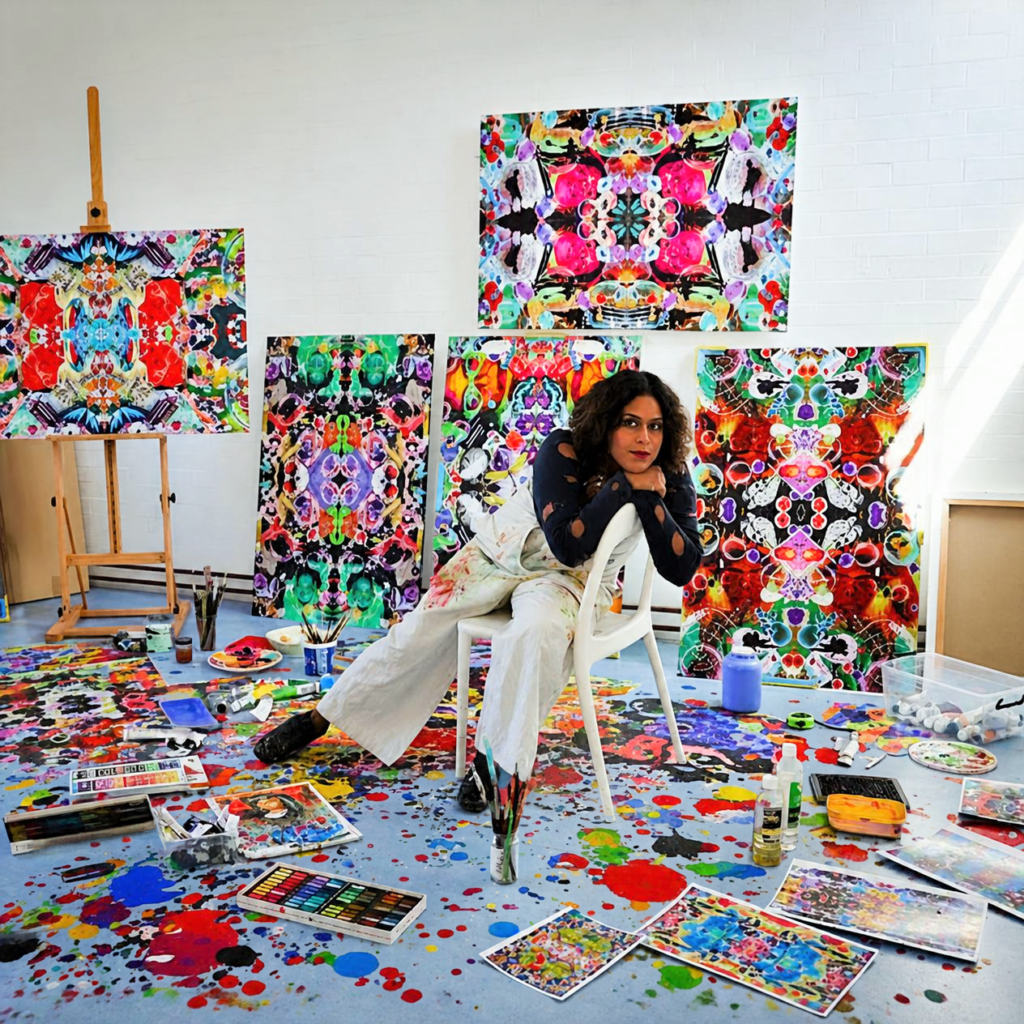
There is a particular vertigo that Sudipta Modi’s new series induces before it can be read: the eye meets a bilaterally symmetrical field so dense with imagery — lotus blossoms, blue bells, tulips, elephants, moths, dragonflies, DNA helices, satellites, beetles, butterflies, crystals, radar signs, the artist’s own doubled and inverted face — that composition itself seems to be making an argument before any single motif does. There is something almost mystical in this abundance, but also something closer to a metaphysics of being: a world in which every fragment appears to have already been mirrored, displaced, and returned to the field in another form. The resulting euphoria is inseparable from a sense of provocation. That argument, I would suggest, is about authorship under siege, and the mandala is its battleground.
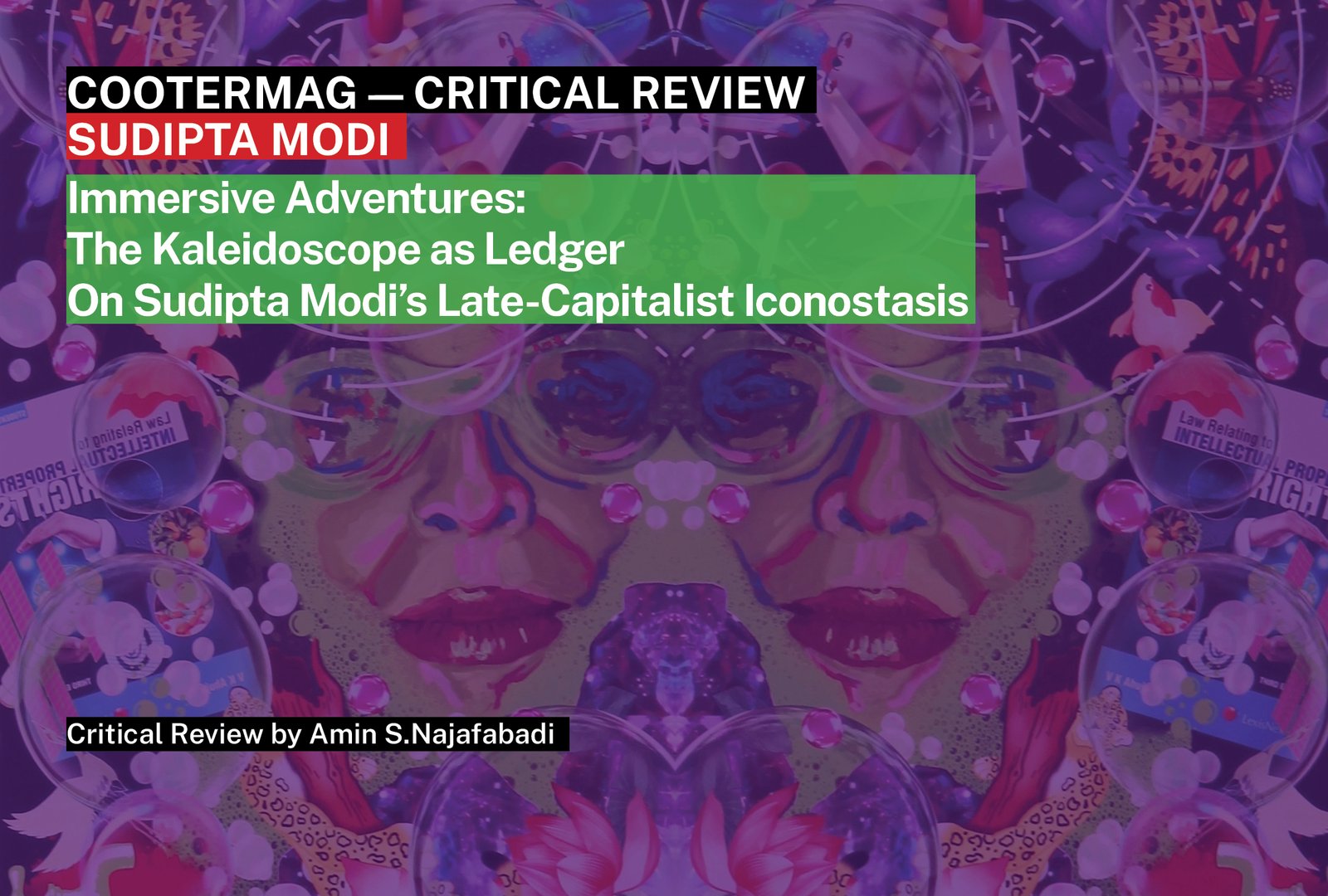
Immersive Adventures extends Modi’s decade-long My Bath project, in which the artist has photographed her own bathing body as a recurring, almost liturgical self-portrait. Here, that source image — a female face emerging and submerging in foam-flooded water, wearing goggles that resemble the glasses of a WWII bomber or air-raider pilot — is folded into a vivid kaleidoscopic structure, mirrored along vertical and horizontal axes until the singular body dissolves into ornament, almost indistinguishable from the lotus petals, soap bubbles, and the jaguar camouflaging itself on a tree branch that surround it. In I Bathe Under Your Radar of Love, this device is at its most legible: a pair of mirrored lips and closed eyes recede into an olive-green field, framed by glass spheres containing tiny painted molecules and beetles, while the perimeter is stitched with a barely legible scrap of legal text — “Law Relating to Intellectual Property Rights” — printed upside down and backwards, as if the copyright page of a law textbook had been fed through the same mirroring apparatus as the artist’s body. The radar imagery and the goggles introduce another register, one in which surveillance, war, protection, and exposure become strangely entangled with the intimacy of bathing. The gesture is not subtle, and it is not meant to be. Modi places the self-portrait and the statute within the same visual register, asking what it means for an image — or an embodied identity — to become subject to claims of ownership, replication, and circulation.
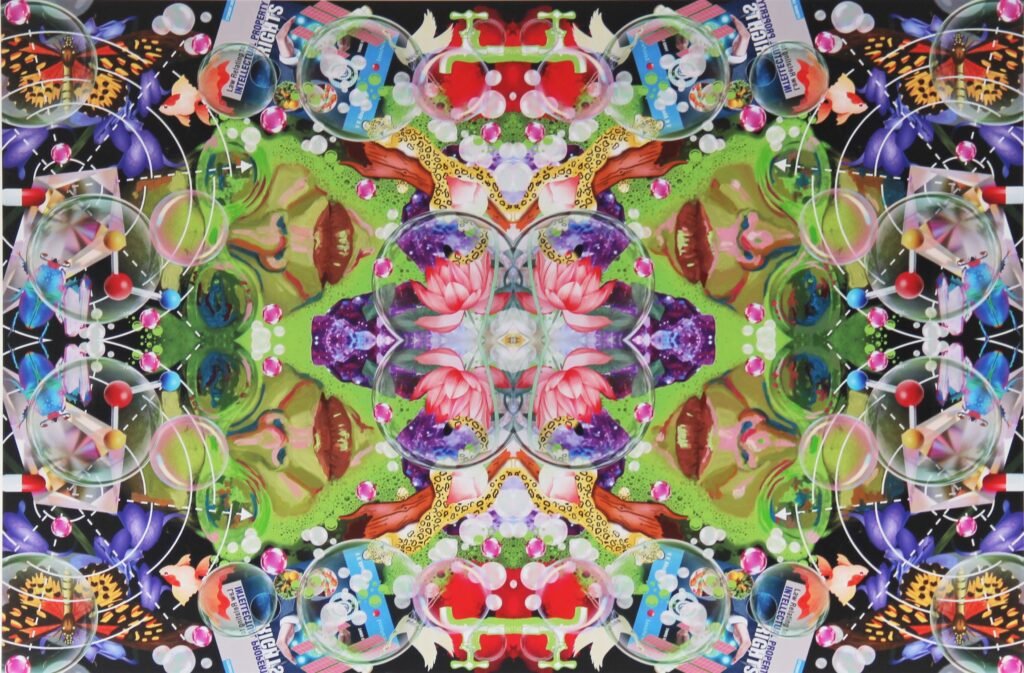
This is where the work’s stated genealogy — Joseph Beuys’s notion of social sculpture, developed through his practice in the 1960s and 1970s — becomes more than a name-check. Beuys’s insistence that art could extend beyond the autonomous object into social relations finds a contemporary inflection here: Modi turns the pressures surrounding authorship, visual labour, intellectual labour, and digital reproduction into something that can be modelled, mirrored, and held up for inspection rather than simply denounced in a wall text. Yet the reference to Beuys also opens a question the work does not entirely resolve. If social sculpture proposes that creative activity can shape social life beyond the conventional boundaries of the artwork, then here the concept may function less as a literal description of the object than as a framework through which its concerns — labour, ownership, technology, and collective culture — can be brought into the same field. The work’s matrix is therefore deliberately borderless: legal text, bodily image, natural forms, technological signs, and cultural fragments are allowed to cross one another’s boundaries. What emerges is less a stable system than an unleashed one, a field in which the boundaries between image, information, body and social structure remain in constant motion.
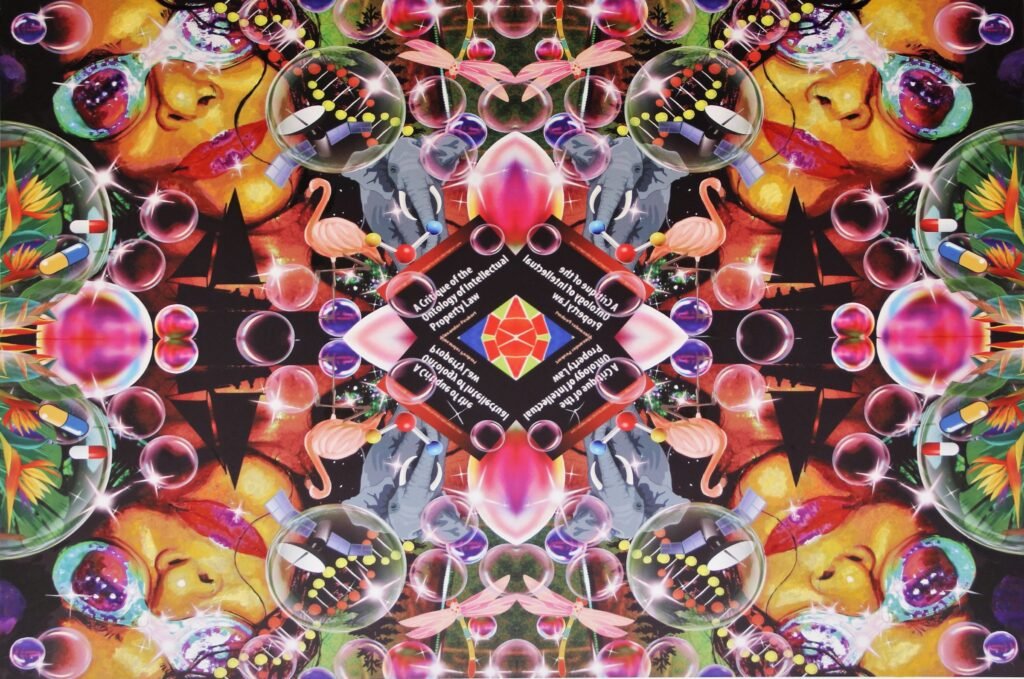
The recurring embedded book covers — Alexander Peukert’s critique of intellectual-property ontology in one work, a volume on IP ordering “beyond borders” in another — function less as citations than as objets trouvés, collaged with the same indifference to hierarchy that Modi affords a flamingo or a satellite dish. In this, she is closer to the tradition of Hannah Höch’s Weimar photomontage of the 1920s and 1930s, where fragments of mass media were cut, recombined, and forced into new relationships, than to any straightforwardly didactic institutional critique. Höch’s materials were often the prosaic debris of modern mass culture — newspapers, magazines, photographs, advertising imagery — but once detached from their original contexts, these fragments ceased to carry a single stable meaning. Collage became a way of taking apart the visual language of propaganda and reassembling it against itself: not simply rejecting the aesthetics of mass culture, but appropriating and redirecting them. The act was therefore both formal and political, a provocation to the authority of the image and to the assumption that meaning remains singular once an image has entered circulation.
Modi’s use of found imagery operates within this longer history of appropriation, but with a different technological pressure surrounding it. The act of recombination itself is not new; what has changed is the scale and speed at which images can now be extracted, recombined, and circulated. This makes the work’s relationship to collage more than historical quotation. It places Modi inside a tradition in which the reuse of existing images has long been a means of destabilising the supposed singularity of visual meaning — and then asks what happens to that tradition when recombination can be automated.
The didacticism is there, but it is smuggled in through beauty, in the way a 1970s album sleeve might smuggle psychedelia through symmetry. That reference point is not incidental: the four-fold, mandala-like structuring of Love Is in Our DNA and Explore the Mine of Love, with their saturated colour fields and kaleidoscopic doubling, sits within the visual lineage of hippie-era gatefold design, a genre that trafficked in fantasies of collective, authorless creativity — a fantasy that large language models now claim, more troublingly, to have automated. Yet Modi’s images do not simply reproduce that euphoria. They make it unstable. The psychedelic surface becomes a place where mysticism, technology, legal language and the politics of authorship occupy the same visual plane.
But there is another kind of labour beneath this visual abundance that complicates the comparison with automated image-making. Modi’s images do not simply accumulate photographic fragments; they are also built through layers of oil paint and, in places, a deliberately heightened photorealism. The photographic image, which can appear to offer an immediate piece of ethnographic information — a face, a body, a cultural sign, an identity — is interrupted and reconstructed through painting. The image is no longer allowed to remain a transparent record of what it depicts. It becomes something made, handled, revised.
The photorealist passages also evoke the authority of older European painting traditions, particularly the illusionistic ambitions associated with Renaissance representation between the fourteenth and sixteenth centuries. Yet in Modi’s work this realism does not simply restore the authority of painting; it is placed inside a much more fractured visual field. The painted layer calls attention to the labour required to make an image convincing, to the hand-eye coordination and cognitive attention involved in selecting, observing, rendering and transforming what is seen. In that sense, the hand becomes part of the argument. Against the apparent frictionlessness of generated images, Modi re-establishes the time and embodied skill of making as something that can be seen within the image itself. The point is not simply that a human hand has touched the surface, but that human autonomy in making depends upon a form of intellectual and embodied attention that cannot be reduced to the visible gesture alone.
This also gives the question of labour a gendered dimension. The history of collage is not only a history of avant-garde appropriation but also one in which forms of handcraft and decorative labour have repeatedly been associated with femininity and relegated to the margins of supposedly serious artistic production. Höch’s own practice is important here: the cut-and-paste logic of photomontage could occupy a space between mass media, craft and fine art, unsettling precisely those hierarchies. Modi’s insistence on hand-layered labour similarly brings the question of who makes an image — and what kinds of labour count as artistic labour — back into the visual field. What appears at first to be an argument about AI and intellectual property therefore opens onto an older question about the value of human work within systems that distribute labour according to gender, class and economic power.
The comparison with Höch, however, also points toward one of the more complicated questions in Modi’s project. Her resistance to automated image-making depends in part on the value she places on accumulation, selection, layering, and the time of making. Yet the visual language itself is built from recombination: found imagery, pre-existing symbols, photographic fragments, painted surfaces, and references are brought together and transformed. This is not a contradiction that invalidates the work. It is perhaps the more interesting problem the work leaves open. Collage and appropriation have long made creativity inseparable from the reuse of what already exists. What changes with generative AI is not the existence of recombination itself, but its scale, speed, and mode of production. Modi’s work therefore raises a question that is harder than a simple opposition between human creativity and machine generation: if both operate through recombination, where exactly does authorship reside — in the source material, in the act of selection, in the labour of transformation, or in the particular relation a maker establishes among borrowed and original elements?
The feminist register the artist names — invoking Simone de Beauvoir explicitly in her statement — operates through the same doubling logic. The Second Sex (1949) famously examined the historical and social production of woman as “the Other,” and Modi’s work registers a related critique of the suppression and containment of gender within inherited social structures. The self-portrait, endlessly mirrored, refuses to resolve into a single, ownable image of “woman,” even as it insists on the specificity of a photographed, embodied self. Read through Beauvoir, Modi’s proliferating, symmetrical selfhood can be understood as a formal analogue to the idea that identity is historically and relationally constituted rather than simply given. But the work does not stop at critique. Its multiplication of the feminine can also be read as an attempt to re-establish femininity as agency and power, opening a different philosophical register through the idea of Shakti — the feminine as force rather than merely as an identity imposed from outside. Here, the self is not a fixed essence to be extracted — as an AI system might extract a recognisable “style” from a body of work — but something that changes with the context in which it appears. The mirrored image is therefore both multiplied and displaced: recognisable, yet never quite singular.
There is also a psychoanalytic dimension to this instability of the self, particularly when the doubled female body is placed within structures of domesticity and architectural order. The house, the interior and the domestic sphere have historically been coded as feminine spaces, while the architecture of those spaces also establishes hierarchies of visibility, privacy and control. Read loosely through Freud, particularly the psychoanalytic preoccupation with the familiar becoming strange, the domestic interior can be understood not simply as a setting but as a psychological and social structure in which desire, repression and identity are organised. Modi’s mirrored bodies complicate that structure: the intimate body is no longer contained within a private architectural frame but multiplied, exposed and circulated as image. The domestic becomes both refuge and apparatus — a place from which the self emerges, but also a structure through which it is ordered.
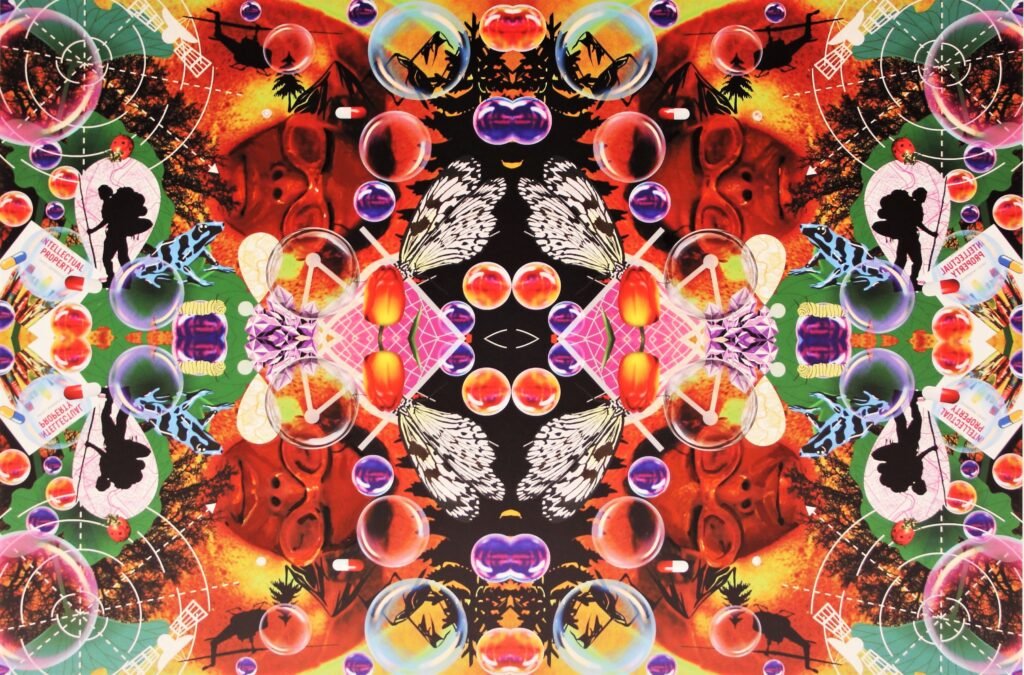
Where the work is less convincing is in the crowdedness of its symbolic economy. Molecules, satellites, colonial-era pharmaceutical capsules, endangered frogs, hikers with backpacks, tulips, caterpillars, crystals, butterflies, radar signs, and embedded book covers, particularly in Explore the Mine of Love, all compete within the same visual field. The maximalism is clearly more than decorative abundance: it offers slowness, accumulation, and hand-layered labour as a counterpoint to the instantaneity associated with prompt-generated images. But there are moments when generative excess tips into visual noise, and the very density that gives the work its energy begins to flatten the hierarchy between its elements. At those moments, the specific political question around intellectual property risks being absorbed back into the decorative pattern. The paradox is worth keeping in view: a strategy intended to resist the frictionless circulation of images can itself become so saturated with images that the viewer struggles to locate the point of resistance.
Still, that risk is arguably the work’s most interesting wager. By choosing maximalism — rather than austerity or textual polemic — as her mode of resistance to generative image systems, Modi stakes her critique on a proposition that is genuinely art-historical rather than merely topical: that the labour-intensive, referential density of collage, a technique whose modern history is inseparable from questions of appropriation, can still register, bodily, as different in kind from a diffusion model’s output — even when, formally, both traffic in recombination. Whether a viewer standing before one of these large-format panels can feel that difference, rather than simply being told about it through an embedded book jacket or a surrounding discourse, is finally an empirical question the work poses rather than answers.
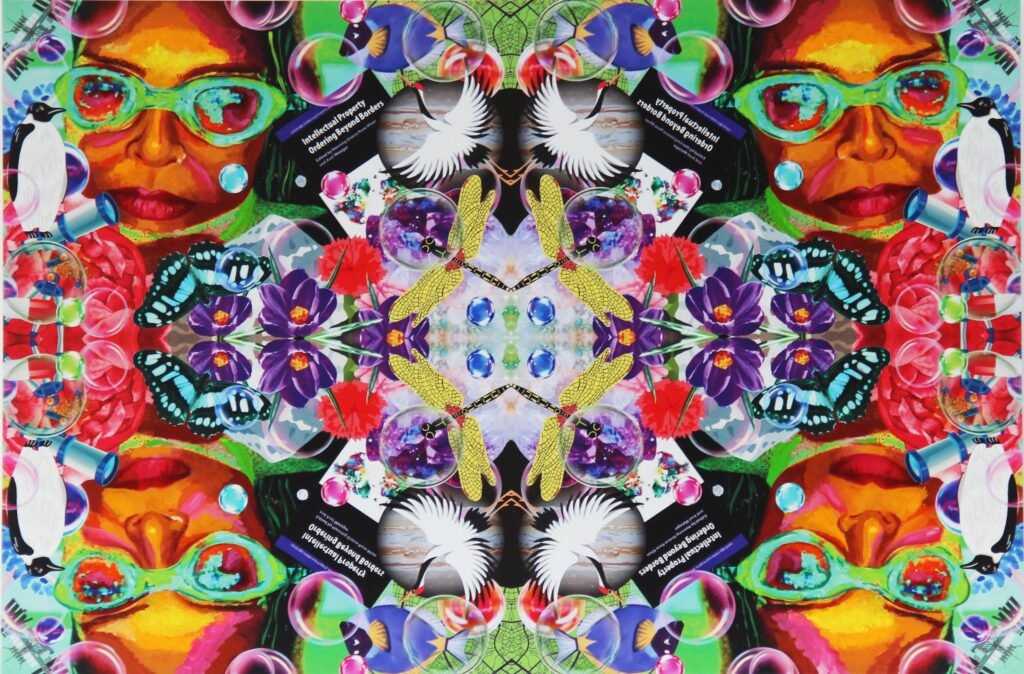
And perhaps this is where Immersive Adventures is most compelling. It does not offer an easy boundary between the authored and the appropriated, the handmade and the automated, the intimate self and the image that circulates beyond it. Instead, it turns that unstable boundary into its subject. The phantasmagoria does not merely multiply the image; it complicates the possibility of locating a single origin for it. In Modi’s hands, excess becomes at once method, resistance, and risk. That the work poses these questions so vividly, in the register of the psychedelic rather than the polemical, is what makes Immersive Adventures worth the sustained look it demands.
Amin S.Najafabadi
Writer, Editor & Art Critic
CooterMag
Artist Links:
Official Website: www.sudiptamodi.com
ArtRewards Profile: Sudipta Modi
Instagram: Sudipta Modi