
Continuum by Marlena Buczek Smith Published by ORO Editions
“Continuum”—where there is no end or no beginning; the continuity of the thread of social consciousness.
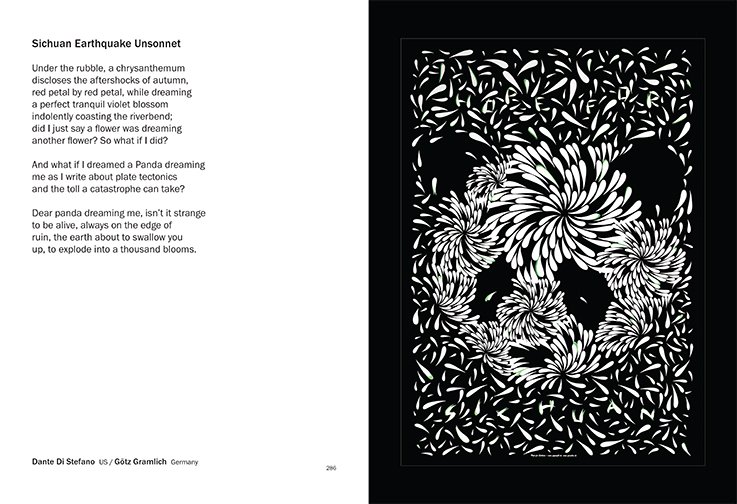
Each chapter of this book is devoted to one of three global concerns: Peace/Anti-War, Human Rights, and Ecology. The initial idea was to invite each designer to think beyond the visual. The book presents powerful images accompanied by poems written by the same designer, or in some cases, a separate poet’s work complements the designer’s image and vice versa. Consequently, this book offers encouragement and empowers its readers and contributors to involvement in global issues.
“Continuum” is a compilation work of 48 designers and 18 poets.
In the endless river of human longing and wound—peace a wounded bird, rights a trembling flame, earth sighing—“Continuum” rises as Marlena Buczek Smith’s eternal song. She named it for the timeless pulse: these struggles have no beginning, no end. With open arms she called 48 designers and 18 poets to dance; to let image-makers grow half-poet, weaving word and vision into a wave that breaks forever on the shore of conscience. From Seymour Chwast’s quiet child cradled in Bob Holman’s gentle verse, the book whispers: resonant art echoes through awareness eternally. Break the chains of labels; perfection in act is poetry itself. Now, let’s begin the interview with this visionary artist.
Marlena Buczek Smith – Continuum
(Published by ORO Editions)
“Continuum” refers to a state of continuity with no clear beginning or end.
How did this concept become the philosophical and structural foundation of the book?
Social consciousness has been a concern for thousands of years, continuously, to the present day and will continue well into the future, hence the book name “Continuum.”
Each chapter of “Continuum” is devoted to one of three global concerns: Peace/Anti-War, Human Rights, and Ecology.
Why were these three themes essential for you to address at this moment in time?
These themes are not only essential at this moment in time, but they have been in the past and, unless human nature changes, these themes will continue to be relevant well into the future.
Continuum brings together the work of 48 designers and 18 poets.
What initially inspired you to create a project that merges visual design and poetry so closely?
I had combined poetry and posters in the past, and thought it would be nice to use this same concept but bring in other contributors.
One of the book’s most distinctive qualities is the strong juxtaposition of posters and poems—two forms that are not often placed side by side with such equal weight.
What possibilities did you see in this bold pairing, and how do you think it reshapes the reader’s experience?
The possibility they can reinforce each other, making the whole more than the sum of its parts.
You invited participating designers to think “beyond the visual.”
What does that mean to you in practice, and how did it influence the contributions you received?
Designers, being continually required to think visually, tend to get typecast by an industry (or industries) obsessed with labels. This is an opportunity to break that mold.
In some cases, the image and the poem are created by the same person; in others, they emerge from collaboration between a designer and a poet.
How does this variation in authorship affect the overall voice and rhythm of the book?
Poster designers having freedom to write text to accompany their own visual work might take the attitude that they are the sole authority on using words as a poetic reflection of their visual. In this sense the poetry is more personal. Whereas, a poet who did not create the accompanying visual work would necessarily be more of a weaver of words.
“Continuum” positions itself not only as an art book, but also as a call for awareness and engagement with social and environmental issues.
In your view, how can graphic design and poetry move beyond expression to become tools for social responsibility and action?
It depends on the individual. If a poster and/or poem resonates one might be inclined to act or embody a more responsible behavior in these areas.
The visual languages in the book are highly diverse, yet they are united by shared ethical concerns.
As the editor and initiator of the project, how did you navigate the balance between individual artistic voices and conceptual coherence?
Conceptual coherence was established by choosing designers whose body of work included these types of ethical concerns. In most cases I choose which artists works were to be included, however in a few cases the artist decided something was more appropriate. In general I acted as a curator.
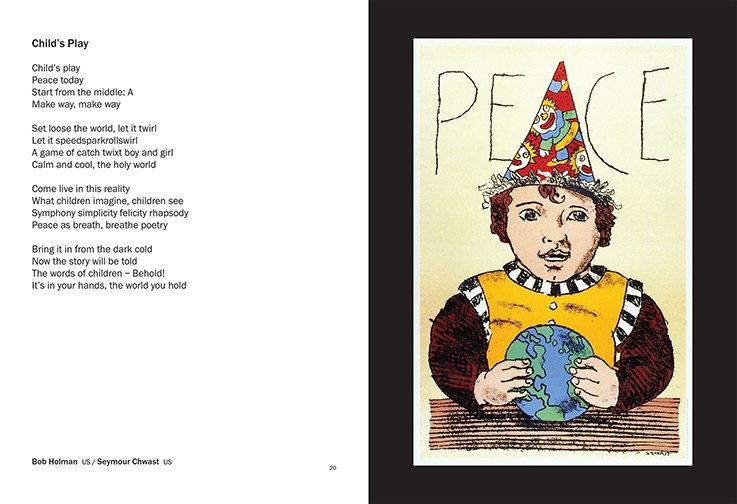
Some pairings in the book stand out as particularly powerful—for example, the “Peace” poster by Seymour Chwast accompanied by a poem by Bob Holman.
Could you speak about the selection of such works and the dialogue that emerges between image and text in these moments?
Seymour Chwast and Bob Holman were specifically chosen to open each charter because their works embody the most essential elements of these topics. The Peace poster simply shows a child at peace, without any counter reference, and Bob Holman’s poetry conjures only what is necessary without being emphatic. It takes years to master the craft at this level.
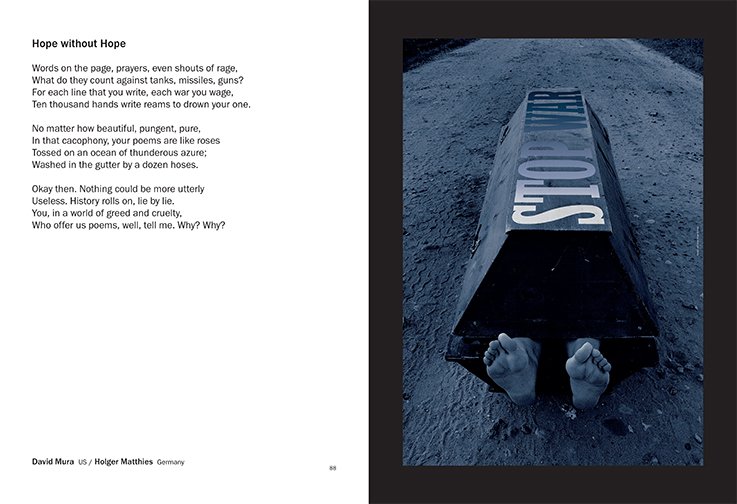
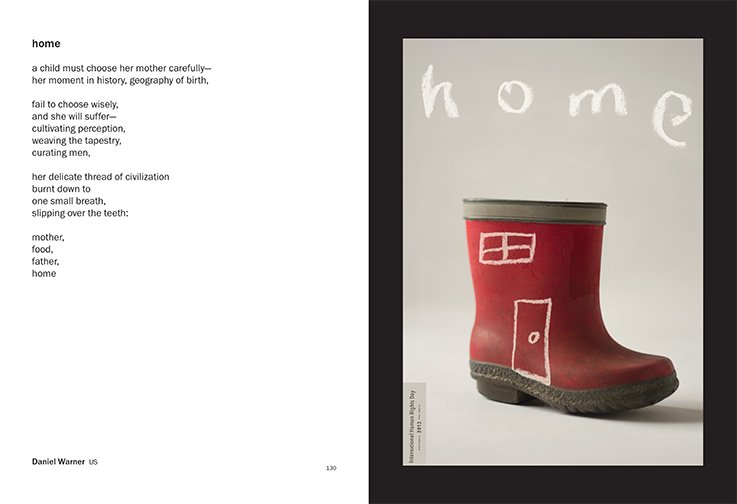
Many of the works in Continuum communicate across cultural and linguistic boundaries.
How important was accessibility and universality for you when shaping this project?
The visual, like music, can communicate to any sentient being. Language is a necessary inhibitor, with English being the language of choice to reach the widest possible audience.
On a personal level, what challenged or moved you the most during the process of developing Continuum?
The fact so many designers and poets decided to be a part of this project. My thanks go to all of them.
To: The LABALS that crack.
Finally,
What do you hope readers—especially young designers and artists—will take away from Continuum and carry forward into their own creative and ethical practices?
Don’t let anyone tell you, you are not capable of doing something (acting of your own accord), whether artistically or any worthwhile endeavor. Perfection of action is art in a certain sense.
Continuum — External Links
Publisher →
https://oroeditions.com/product/continuum
Project Page →
http://marlenabuczek.com/continuum.html
Bookstore →
https://shop.posterhouse.org/continuum.html
Video →
https://www.youtube.com/watch?v=91ORGtrDMM0
Interview by Amin S.Najababadi
………………….
Curious about what inspires today’s artists?
Quiet Protest: Conversation with Chris Iduma
cootermag.com/interviews/quiet-protest-conversation-with-chris-iduma/